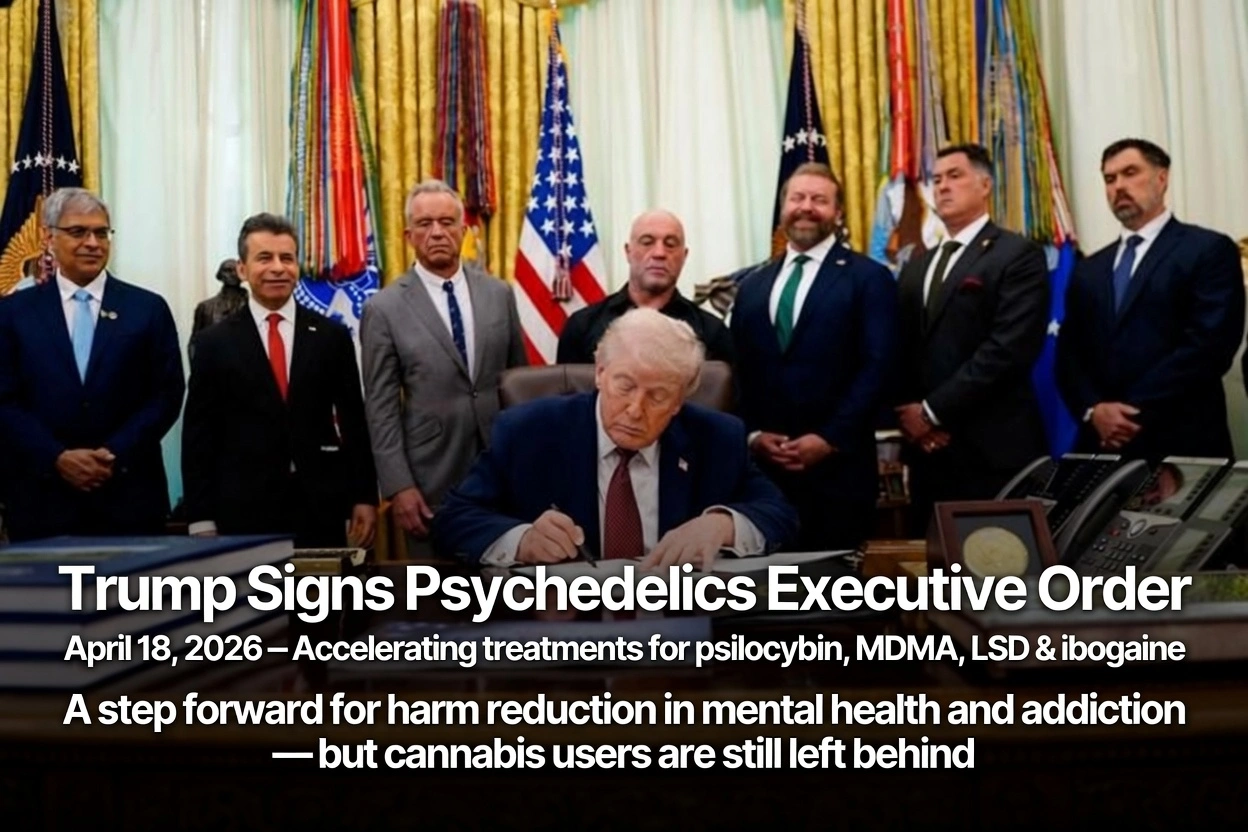
On April 18, 2026, President Trump signed an executive order in the Oval Office with podcaster Joe Rogan seated nearby. The order was titled “Accelerating Medical Treatments for Serious Mental Illness.” The optics were unusual. The policy implications were not.
Stripped of the ceremony, what Trump signed was one of the most significant federal movements toward harm reduction in a generation, not framed that way, perhaps intentionally, but structurally that is what it is. It is worth understanding exactly what changed, why it matters for the field of addiction treatment, and where the policy momentum quietly stops.
What the Executive Order Actually Does
The order targets four substances currently classified as Schedule I under the Controlled Substances Act: psilocybin, MDMA, LSD, and ibogaine. All four have received Breakthrough Therapy designations from the FDA for conditions including treatment-resistant depression, PTSD, and major depressive disorder.
The order does four things:
1. Commissioner’s National Priority Vouchers. The FDA is directed to issue priority review vouchers to psychedelic drugs that have received Breakthrough Therapy designations. These vouchers accelerate the approval pathway for substances the administration deems aligned with national health priorities, in this case, serious mental illness.
2. Right-to-Try pathway for investigational psychedelics. The FDA and DEA are required to establish a formal pathway under the Right-to-Try Act allowing eligible patients to access investigational psychedelic drugs that are under FDA review and have met basic safety benchmarks, before those drugs have received full approval. This is a significant expansion of access.
3. Expedited rescheduling. The Attorney General, in consultation with the Department of Health and Human Services, is directed to initiate and complete rescheduling review for any Schedule I substance that has successfully completed Phase 3 clinical trials for serious mental health disorders. The instruction is explicit: rescheduling should proceed “as quickly as practicable.”
4. $50 million in federal funding. States that have enacted or are developing programs to advance psychedelic drug treatment for serious mental illness are allocated at least $50 million in federal support.
References: White House Fact Sheet | Fox News | PBS NewsHour
Why This Is a Harm Reduction Story
The phrase “harm reduction” does not appear in the executive order. It rarely appears in documents that advance harm reduction principles, because the politics of the term are complicated. But the underlying logic is identical.
Harm reduction, as a clinical and public health framework, is the practice of reducing the negative consequences of substance use without requiring abstinence as a precondition for care. It meets people where they are. It treats imperfect outcomes as meaningful progress. It prioritizes safety over moral framing.
The executive order does exactly this with ibogaine. Ibogaine, a Schedule I psychoactive compound derived from the iboga plant, has been studied extensively for its ability to dramatically reduce opioid withdrawal symptoms and interrupt addiction cycles, sometimes in a single dose. Veterans programs using ibogaine have shown profound results for opioid use disorder and PTSD simultaneously. The drug is not safe in all contexts and requires medical supervision. But the point is that ibogaine works by using one substance to reduce the harm of dependence on another. That is harm reduction.
MDMA-assisted psychotherapy for PTSD follows the same logic. PTSD and substance use disorder are deeply entangled conditions. Treating the trauma with MDMA-assisted therapy often reduces the substance use that was serving as self-medication. You are not eliminating drug use from the equation; you are using drug-assisted treatment to address the root cause of problematic use.
Psilocybin for depression, similarly, addresses the affective floor that sustains addiction cycles for many patients.
This executive order, in practice, authorizes the use of scheduled substances to treat the conditions that drive substance use disorder. That is a harm reduction paradigm, regardless of the language used to describe it.
The Substances That Didn’t Make the List
The executive order is precise in its scope. It covers psychedelics with Breakthrough Therapy designations for serious mental illness. Cannabis is not on that list, and is not adjacent to it.
There is a separate, earlier executive order (December 2025) directing the Attorney General to move cannabis to Schedule III under the Controlled Substances Act. That rescheduling is still in progress. As of April 2026, cannabis remains a Schedule I substance federally, with the transition in its critical administrative phase. The two orders exist on parallel tracks that do not intersect.
This matters because the logic that applies to ibogaine (that a substance can be used therapeutically to reduce harm) applies equally to cannabis. Cannabis is already used by millions of people to manage pain, anxiety, and sleep disturbance. Many of those people are self-medicating conditions that clinical systems have failed to address adequately. But cannabis users are not the intended beneficiary of this executive order, and the harm reduction infrastructure being built around psychedelics does not reach them.
Denmark: Where Cannabis Falls Entirely Outside the Frame
If the gap is visible in the United States, it is even more pronounced in Denmark, and worth examining as a case study in how harm reduction policy can simultaneously be advanced and incomplete.
Denmark’s harm reduction infrastructure is legitimately world-class. The country operates needle and syringe exchange programs, supervised drug consumption facilities, and heroin-assisted treatment programs for people with long-term heroin dependence. Copenhagen’s harm reduction services are frequently cited as a model. The Danish approach to opioids, stimulants, and hard drug use is pragmatic, evidence-based, and clinically serious.
Cannabis occupies an entirely different category. Recreational cannabis remains illegal under Danish law. First-time possession of small amounts (below 10 grams of hashish or 50 grams of marijuana) typically results in a fine of 70–500 DKK. The current Danish government maintains a formal zero-tolerance position, and most parties in the coalition oppose legalization.
Medical cannabis is a different story: Denmark made its medical cannabis pilot program permanent effective January 1, 2026. Physicians can now prescribe cannabis products (dried flower, oils, capsules, tablets) without restriction to a specific conditions list. The state reimburses 50% of patient costs up to DKK 20,000 per twelve-month period. This is a meaningful expansion.
But the gap remains. Over 50% of Danes support recreational legalization. 80% support medical use. The substance is widely used. And harm reduction for cannabis (the institutional infrastructure that would catch users before they become patients) does not exist.
Here is the Danish cannabis fun fact that illuminates the absurdity of the situation: hashish, not marijuana, is the dominant cannabis product in Denmark. It has been for decades. Imported primarily from Morocco via Spain, Danish hash has a cultural history stretching back to the 1960s and occupies a semi-tolerated status in public consciousness that its legal classification entirely contradicts. The famous Freetown Christiania in Copenhagen operated an open cannabis market for decades before it was formally dismantled under political pressure. Danes smoke hash. The policy treats it as though they don’t.
The result is a population of cannabis users (significant in number, varied in their relationship with the substance) who fall outside Denmark’s otherwise sophisticated harm reduction ecosystem. They are not captured by opioid programs. They do not qualify for heroin-assisted treatment. Medical cannabis requires a clinical diagnosis and a prescribing physician. And recreational use, by definition, has no institutional point of contact at all.
What Falling Out of the Frame Actually Looks Like
It is worth being specific about who this population is, because the clinical picture is not what the policy conversation assumes.
These are not, in most cases, people in acute crisis. They are people whose cannabis use has become habitual, often starting as self-medication for anxiety, insomnia, or chronic pain, and whose patterns have gradually shifted from intentional to automatic. Use frequency increases. The number of sessions per day creeps up. Sleep without cannabis becomes difficult. Motivation declines. Relationships are affected.
The clinical threshold for Cannabis Use Disorder (CUD) diagnosis requires two or more symptoms from a defined list within a twelve-month period. Many of these users meet that threshold. Most have never been assessed, because the system has no mechanism to reach them. They are not seeking help at opioid treatment centers. They are not presenting in emergency departments. They exist in the space between casual use and clinical crisis, a space that harm reduction is designed to address, and that cannabis policy in most countries has not yet structured itself to serve.
This is the population that falls out. Not through any failure of their own, but because the institutional frame that would catch them has never been built.
Where Tracking Fits Into This Gap
The harm reduction model does not require crisis as a precondition for intervention. It requires contact. And contact, in the absence of institutional infrastructure, begins with the individual having some mechanism to understand their own patterns.
This is where real-time tracking matters: not as surveillance, and not as a substitute for clinical care, but as the data layer that makes harm reduction possible before someone reaches a threshold that triggers formal intervention.
SmokingTracker is built around this premise. The platform provides cannabis users with a three-tap logging interface that captures session frequency, timing, mood, cravings, and triggers in real time, not reconstructed from memory at the end of the week. For individuals, this data is their own: a private, running picture of their relationship with the substance, with no gatekeeping.
For clinicians, SmokingTracker functions as a clinical EMA (Ecological Momentary Assessment) platform, pulling real-time between-session data into a traffic-light dashboard, supporting measurement-based care for exactly the population that US and Danish policy has been slowest to reach. Reports are exportable. Data is GDPR and HIPAA compliant. The client owns their data.
The Trump executive order is a meaningful step. It extends the logic of harm reduction to a category of substances that has been locked out of clinical access for decades. That matters enormously for the patients ibogaine and MDMA-assisted therapy can reach.
But harm reduction is not a policy category. It is a clinical orientation: the belief that every point of contact is an opportunity to reduce harm, regardless of whether the person in front of you meets a diagnostic threshold or lives in a country with progressive drug policy. Cannabis users in Denmark, and everywhere else, deserve the same orientation.
They deserve a way in.
References
- Executive Order: “Accelerating Medical Treatments for Serious Mental Illness”, The White House (April 18, 2026)
- Fact Sheet: President Donald J. Trump is Accelerating Medical Treatments for Serious Mental Illness, The White House
- Trump signs executive order directing FDA to review psychedelics, Fox News
- Trump joins with Joe Rogan as he signs order to speed up psychedelic review, Al Jazeera
- Trump signs order to hasten review of psychedelics, PBS NewsHour
- Medical Cannabis In Denmark Made Legal, Permanently, Hemp Gazette
- Is Weed Legal in Denmark? 2026 Marijuana Laws, The Cannigma
This article is part of the SmokingTracker Knowledge Base, a resource for harm-reduction-informed clinicians working with cannabis use and behavioral addiction.