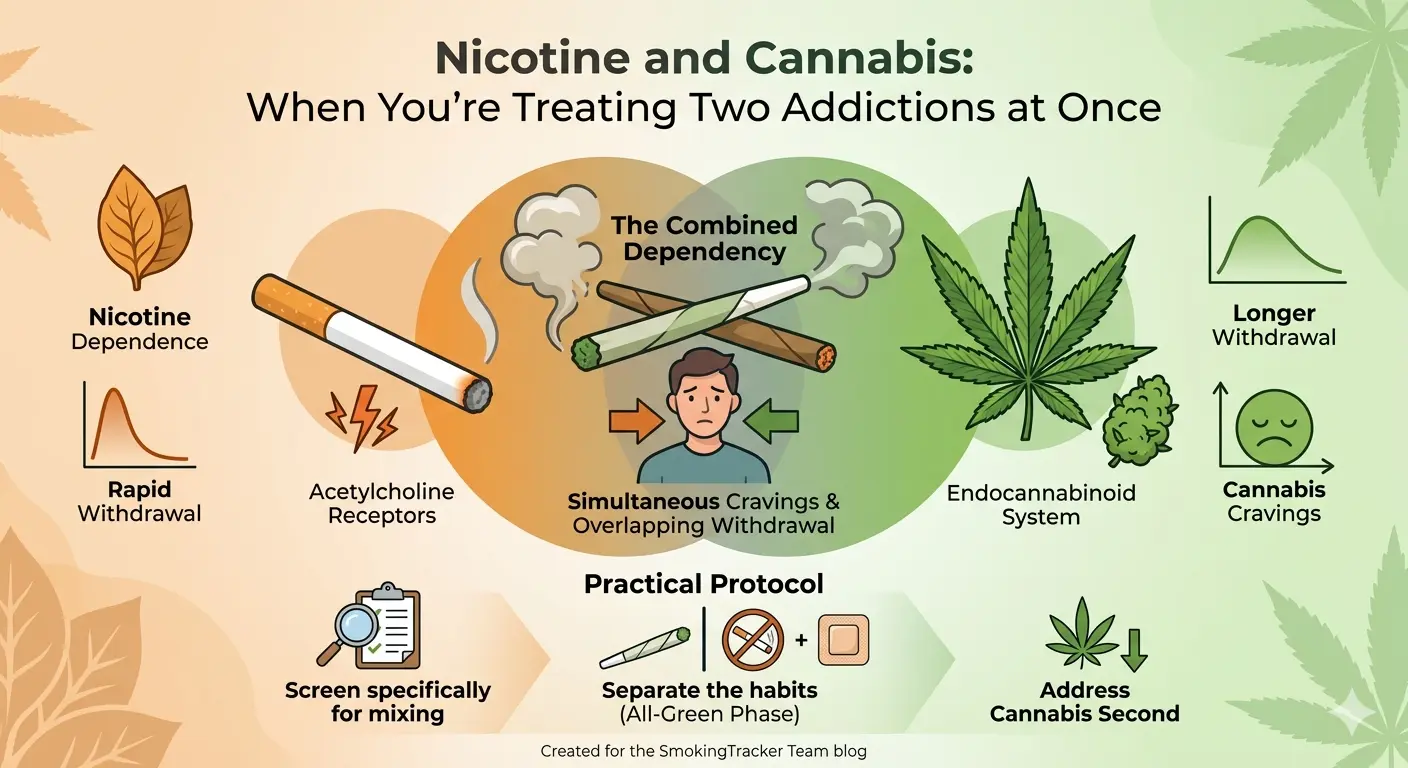
Polysubstance use of cannabis and tobacco, smoked together in spliffs or blunts, is more common than standard intake assessments capture. Studies estimate that 35–70% of cannabis users in the US regularly combine cannabis with tobacco (Amos et al., 2004; Schauer et al., 2016), yet most treatment plans address only the cannabis dependency. When both are present, clients face two overlapping withdrawal timelines that compound each other and significantly increase early dropout risk.
When a client rolls cannabis with tobacco, you’re not looking at one substance problem. You’re looking at two, with separate neurological dependencies, separate withdrawal timelines, and often separate emotional functions.
Most treatment plans only address one of them.
The gap is understandable. Cannabis is why the client is in treatment. Tobacco gets folded into the background as a delivery method rather than a dependency in its own right. But the clinical consequences of that blind spot are significant: clients who try to reduce cannabis while unknowingly managing nicotine withdrawal simultaneously are fighting two battles they only prepared for one of. The resulting failure often gets attributed to motivation, when the real problem was the treatment frame.
How Common Is the Combination?
More common than most intake assessments capture. Studies consistently find that a substantial portion of cannabis users in the US (estimates range from 35–70% depending on the population and region) regularly use tobacco alongside cannabis, either in blunts (cannabis rolled in a tobacco leaf wrap) or spliffs (cannabis mixed directly with tobacco).
The clinical undercount happens because clients don’t self-identify as smokers. They’ll say “I smoke weed” and genuinely not include tobacco in that answer, because they don’t smoke cigarettes and don’t think of themselves as tobacco users. The tobacco is just what’s in the blunt wrap, or just how they stretch their supply, or just how they’ve always done it.
This means the standard intake question (“do you smoke cigarettes?”) misses a significant portion of combined users. The question that catches it is more specific: “When you smoke cannabis, do you mix it with tobacco or use tobacco wraps?”
Two Dependencies, Two Withdrawal Patterns
The neurological mechanisms are distinct.
Nicotine acts on the brain’s acetylcholine receptors and triggers a rapid, reliable dopamine response. Tolerance develops quickly, within weeks of regular use, and the withdrawal timeline is compressed: symptoms peak at 24–72 hours and largely resolve within 2–3 weeks. The acute withdrawal is uncomfortable (irritability, difficulty concentrating, restlessness, increased appetite) but relatively short.
Cannabis acts primarily on the endocannabinoid system. Tolerance develops more slowly, and withdrawal has a longer, flatter timeline: symptoms emerge over days, peak around day 4–10, and the mood and sleep disruption can linger for weeks.
When a client tries to stop both simultaneously, these two withdrawal curves overlap and compound each other. The irritability and restlessness of nicotine withdrawal hits in the first days. The mood instability and sleep disruption of cannabis withdrawal peaks around day 5. The anhedonia of the sub-acute cannabis phase extends into weeks 2–4. Experienced from the inside, this doesn’t feel like two separate processes; it feels like one overwhelming, unrelenting discomfort that confirms the client’s worst fears about what sobriety feels like.
This is a major driver of early dropout that often goes unexamined.
Which to Address First?
There is no universal protocol, but the clinical logic for addressing nicotine separately is strong.
Keeping cannabis while removing tobacco first (shifting to “all green” use, cannabis only without tobacco, before beginning cannabis reduction) has several advantages:
It reduces the withdrawal burden. Nicotine withdrawal resolves in 2–3 weeks. Once it’s done, the client is no longer fighting two things at once when they eventually address cannabis.
It often reduces overall cannabis consumption incidentally. Many clients who mix tobacco find that rolling a joint without tobacco is a more deliberate act, less automatic, less convenient. The quantity of use often drops without the client specifically trying to reduce, simply because the habit structure changes.
It provides an early win. “All-green for two weeks” is a concrete, achievable milestone that builds self-efficacy. Clients who have never succeeded at reducing their use suddenly have evidence that they can change a habit. That evidence matters for the harder work ahead.
Nicotine Replacement Therapy becomes available. If you’re addressing the nicotine dependency directly, NRT (patches, gum, lozenges) is well-evidenced, accessible, and dramatically reduces the physical discomfort of nicotine withdrawal. It can’t be deployed if the tobacco is embedded inside the cannabis habit and treated as incidental.
The Misidentified Trigger
One of the most practically useful clinical insights about combined use is what it does to craving attribution.
Clients who mix tobacco and cannabis daily for years lose the ability to distinguish which substance they’re craving at any given moment. The brain has fused the two reward signals: cannabis and nicotine have been delivered together, reliably, for years. The cravings are experienced as one urge, not two.
This creates a specific treatment problem: when the client feels an intense craving and reaches for relief, they’re often responding to nicotine (the faster-acting, more acutely uncomfortable withdrawal) but attributing the relief to cannabis. The cannabis gets credit for resolving a craving it didn’t cause.
When you separate the two streams, something clarifying happens. Clients start to notice: “That 10am urge is different from my evening urge. The morning one is edgy and physical. The evening one is more about winding down.” That differentiation is therapeutically significant. It’s much easier to address a craving once you know what you’re actually craving.
A Practical Protocol for Mixed-Use Clients
At intake: Ask specifically about tobacco-in-cannabis use. Make it routine, not a follow-up. The answers will change what you plan.
Psychoeducation early: Name the two dependencies explicitly. Most clients haven’t thought about it this way, and many find the framework genuinely clarifying rather than overwhelming. “You’ve been managing two habits simultaneously, that’s more complex than most people realize, and it explains why cutting back has felt harder than it should.”
Consider NRT proactively: If the client is open to addressing the nicotine component, NRT can be introduced as support for the “all-green” transition, not as a smoking cessation intervention per se. Framing matters: this isn’t about quitting tobacco for health reasons (which triggers resistance in many clients), it’s about removing one variable so the cannabis work can actually work. A Cochrane meta-analysis (Stead et al., 2012) found that NRT approximately doubles quit success rates compared to willpower alone across all forms of tobacco use.
Set “all-green” as an early milestone: Before talking about reducing cannabis quantity, establish the form of use. A week or two of cannabis-only sessions is an achievable early goal that changes the dependency landscape meaningfully.
Frequently Asked Questions
How common is mixing cannabis with tobacco? Estimates range from 35–70% of cannabis users in the US, depending on the population and region. The undercount in treatment settings happens because clients don’t self-identify as tobacco users. The intake question that catches it is specific: “When you smoke cannabis, do you mix it with tobacco or use tobacco wraps?” The standard “do you smoke cigarettes?” misses most of them.
What is the difference between a spliff and a blunt? A spliff is cannabis mixed directly with loose tobacco and rolled in a paper. A blunt is cannabis rolled in a tobacco leaf wrap (such as a cigar shell or blunt wrap) without loose tobacco mixed in. Both deliver nicotine alongside THC. Clinically, both create co-occurring nicotine dependence, even in clients who do not consider themselves tobacco users.
Does mixing tobacco with cannabis affect withdrawal? Yes, significantly. Nicotine withdrawal peaks within 24–72 hours and largely resolves within two to three weeks. Cannabis withdrawal peaks around days 4–10 and the mood disruption can persist for weeks. When a client stops both simultaneously, these timelines overlap and compound: the client experiences a longer, more intense, more continuous discomfort that often exceeds their capacity to tolerate it. This is a major driver of early dropout that often goes unexamined.
Should clients quit cannabis and tobacco at the same time? Not necessarily. Addressing nicotine first (transitioning to “all green,” cannabis only, before beginning cannabis reduction) reduces the withdrawal burden, allows NRT to be deployed, and often reduces cannabis use incidentally as the habit structure changes. It also provides an early concrete win that builds self-efficacy. The clinical logic for sequential rather than simultaneous cessation is strong for most mixed-use clients.
What is Nicotine Replacement Therapy (NRT) and does it help? NRT includes patches, gum, lozenges, inhalers, and nasal sprays that deliver controlled doses of nicotine without tobacco smoke. Cochrane meta-analysis data (Stead et al., 2012) shows NRT approximately doubles quit success rates compared to willpower alone. For mixed cannabis-tobacco clients, NRT is most effectively framed as a tool for separating the two habits rather than as a smoking cessation intervention, which reduces resistance.
This article was written by SmokingTracker, drawing on peer-reviewed research in cannabis use disorder treatment.
In SmokingTracker, clients log whether each session is “all green” (cannabis only) or mixed with tobacco. Over time, this creates a clear picture of the nicotine dependency operating inside the cannabis habit. Clinicians can see the two patterns separately, track the all-green transition as a milestone, and use the data to calibrate what the client is actually ready to work on. Book a demo to see how polysubstance tracking works in a real clinical workflow.