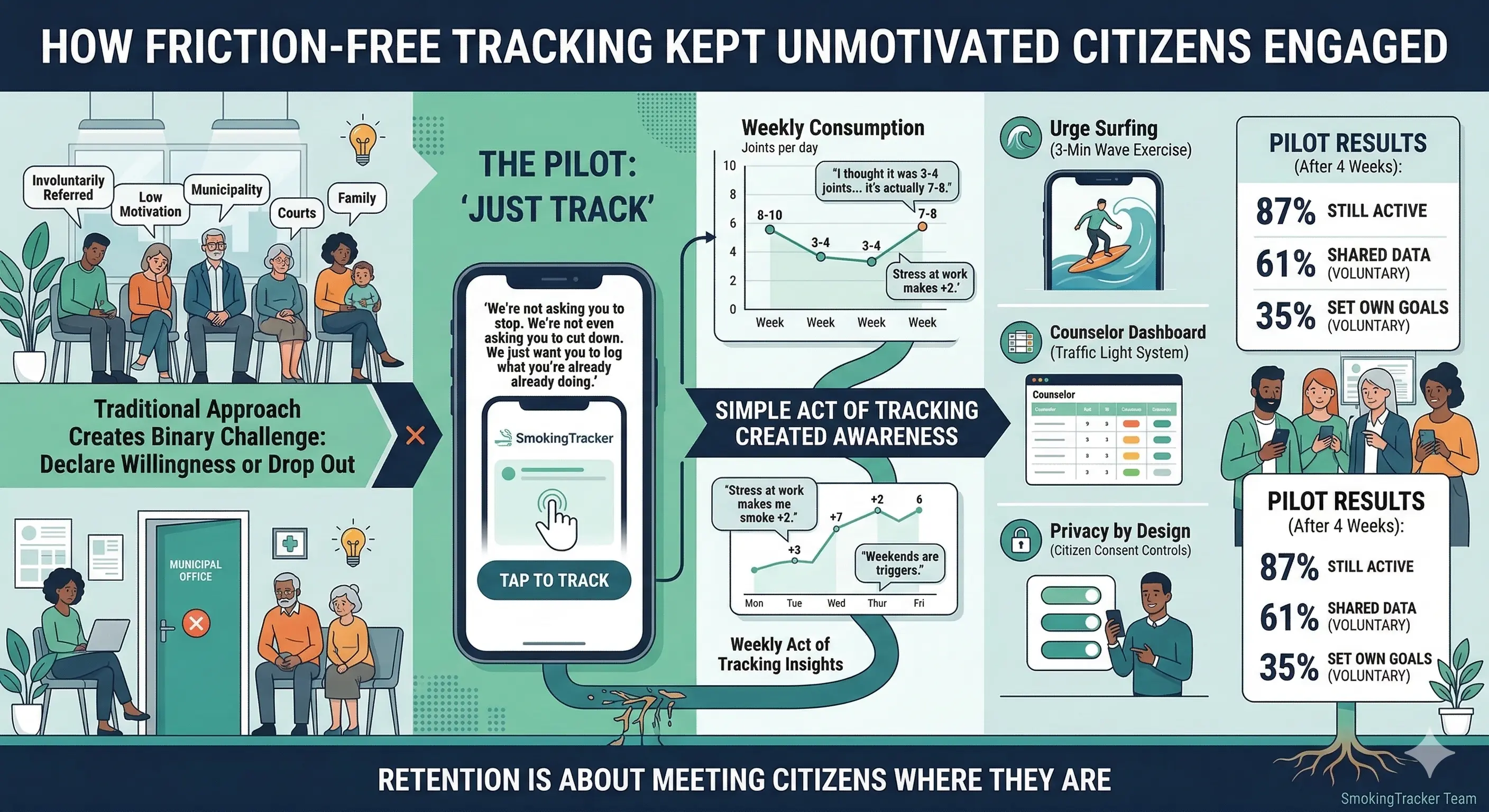
Friction-free tracking is a treatment engagement approach where clients are asked only to observe and log their behavior, without any requirement to change it. Rather than demanding commitment to a goal upfront, it lowers the barrier to entry for involuntary or ambivalent clients.
For most outpatient substance use treatment centers, retaining clients is the biggest challenge, especially clients referred against their will by the courts, a probation officer, or family members. These clients often drop out within the first two weeks, before any therapeutic work has had a chance to begin.
But what if the solution isn’t to push harder, but to take a step back?
The Problem With the Traditional Approach
Most treatment programs require the client to declare willingness to stop or reduce. It sounds reasonable, but creates a binary situation: either you’re “ready,” or you’re out.
For clients who didn’t choose to be there, this is a guaranteed recipe for early dropout. They feel pressured, lose ownership, and shut down. Asking for commitment before trust is established is asking for a commitment that can’t be kept.
The Approach: “Just Track”
Friction-free tracking inverts the sequence. Instead of asking clients to set goals, the initial ask is minimal:
“We’re not asking you to stop. We’re not even asking you to cut down. We just want you to log what you’re already doing.”
Clients start with a single consumption method and one instruction: log your session when it happens. No goals, no limits, no pressure. The only thing they’re committing to is observation.
Why It Works
The mechanism is well-documented in self-monitoring research: tracking behavior changes behavior, even without explicit goals. When clients can see their own patterns (across time, across context, across mood) they encounter information that is hard to dismiss because they generated it themselves.
Clients who assumed they were using “3–4 times a week” often discover it’s daily. Clients who thought they smoked “a joint or two” often find the actual count is twice that. This gap between perceived and actual use, surfaced by their own data, is often the first moment of real curiosity about change.
Importantly, that curiosity comes from within, not as an external demand from a counselor. Self-generated insight is a more durable motivator than externally imposed goals, and it arrives on the client’s own timeline.
The consent model reinforces this: clients who start tracking privately can choose to share data with their counselor when they feel ready. That act of sharing (not a form, not a disclosure requirement) is itself a therapeutic step.
What This Means for Your Center
SmokingTracker’s Privacy by Design model is built precisely for this approach:
- The client controls everything: They choose what to share with the counselor via granular consent toggles
- No judgment: The app logs without moralizing. There are no “you failed” messages
- Counselors see only what’s shared: The traffic light dashboard shows activity level, not details, unless the client has given consent
This structure makes it possible to invite the most reluctant clients into a tracking relationship without asking them to expose themselves before they’re ready.
Conclusion
Retention isn’t about pushing harder. It’s about meeting clients where they are, and giving them a tool that rewards awareness over perfection. For involuntary and low-motivation clients, removing the initial commitment requirement isn’t lowering the bar. It’s changing what the bar is.
Frequently Asked Questions
What is “friction-free tracking” in substance use treatment? Friction-free tracking removes the requirement to commit to change as a precondition for participating in treatment. Clients are asked only to log what they’re already doing. The goal is to keep involuntary or ambivalent clients engaged long enough for self-generated insight to emerge, because awareness that comes from within is a more durable motivator than externally imposed goals.
Does SmokingTracker require clients to commit to quitting? No. SmokingTracker is designed to work with clients who are not yet ready to reduce or stop. The app logs without judgment. There are no “failure” states. The only initial request is that clients record their sessions when they occur. Goals and reduction targets can be introduced later, once a client has decided they want to set them.
How does awareness from tracking lead to behavior change? Tracking creates data that clients can see about themselves, and self-observation changes behavior even without explicit behavioral goals, a phenomenon well-documented in self-monitoring research. Clients who underestimate their use (“I thought it was 3–4 joints a day, it’s actually 7–8”) often initiate reduction goals on their own once they can see the pattern. The data becomes the therapeutic lever.
Why do involuntary clients drop out of treatment early? Early dropout among court-referred or low-motivation clients is primarily driven by perceived loss of autonomy: the feeling that the program is happening to them, not with them. Friction-free tracking addresses this by giving clients an immediate, low-stakes action they control completely. Logging is not compliance. It’s observation. That distinction matters.
This article was written by SmokingTracker. It draws on the literature on self-monitoring, motivational interviewing, and treatment engagement in substance use disorder settings. This article is informational and does not constitute clinical advice.
Want to try this approach at your center? Book a demo and see how SmokingTracker can integrate into your existing workflows.